
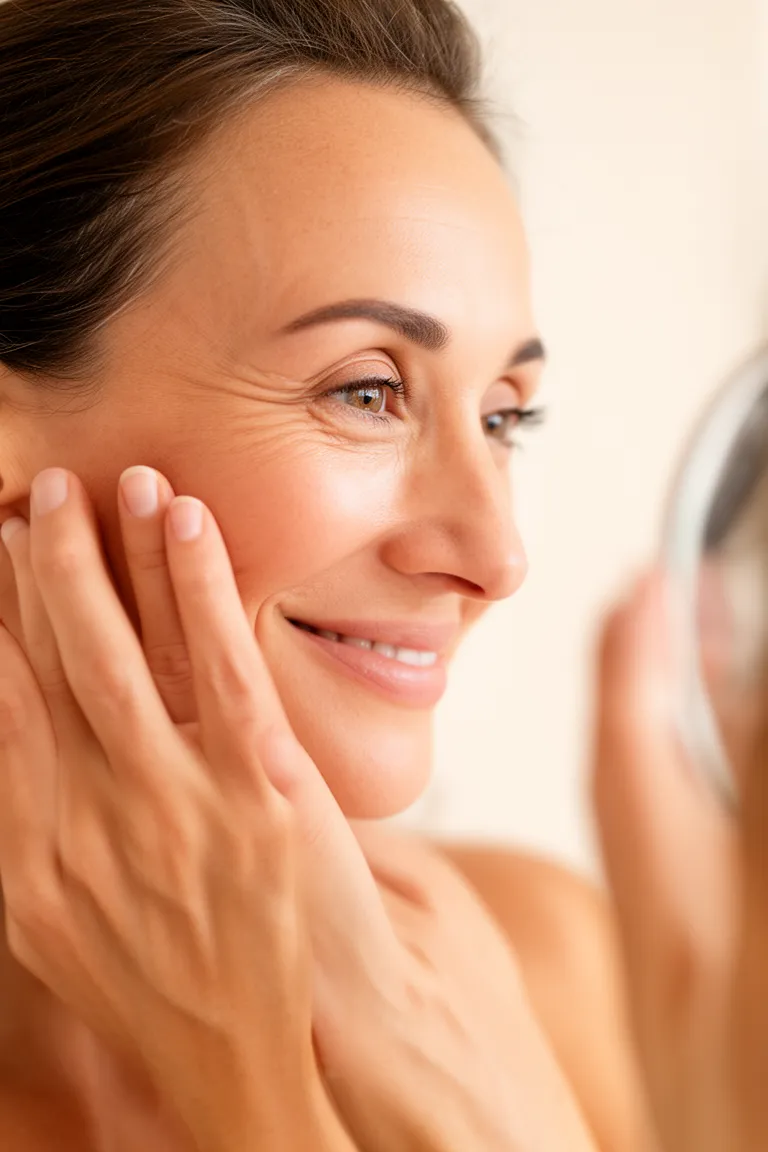
I was getting ready for a video call, the kind where you can see your own face staring back at you, and I watched myself lean forward. The skin along my jawline didn’t snap back with me. It just… lingered. I froze. I’m 47. I run three times a week. My diet is more vegetables than not. I’m religious about my SPF 50. I do all the things. Yet there it was—a softness, a slight surrender in the contour of my face that no amount of squats or spinach seemed to touch. It felt deeply, personally unfair. I’d followed the rules, and my skin was rewriting them anyway. That moment wasn't just about vanity; it was a profound sense of my body quietly shifting into a new phase, and my trusted playbook suddenly having no answers.
That moment sparked a frantic, expensive, and ultimately frustrating few months. I bought every jar that promised “lifting,” “firming,” and “dramatic rejuvenation.” I’d stare in the mirror after applying some luxe cream, willing my reflection to match the airbrushed “after” picture on the box. The glow would fade by noon, the tight feeling was just dehydration, and the underlying looseness remained. I felt duped and skeptical. Was this just it? Was “restoring skin elasticity after 40” a marketing fantasy sold to women like me? I was caught between the glossy promises and the silent shrug of my healthy lifestyle, feeling utterly alone in the gap.
I had to believe there was a middle ground between miracle-in-a-jar lies and just giving up. My journey out of that frustration wasn’t about finding one magic product. It was about a fundamental shift in understanding: from chasing quick fixes to patiently supporting my skin’s biology. It turns out, healthy habits are the essential foundation, but after 40, they’re often maintenance, not renovation. Here’s what I had to learn the hard way—and what finally started to make a tangible difference.
The Morning I Realized My Healthy Routine Wasn’t Restoring My Skin Elasticity
It wasn’t just that one video call. It was the cumulative effect of small, quiet betrayals. It was the way my foundation would settle into a texture I didn’t recognize by mid-afternoon. It was pinching the skin on the back of my hand and watching it settle back slowly, like tired dough. This was my skin losing elasticity after 40 despite wearing sunscreen, drinking water, and eating my greens. I had been an A+ student in prevention, but I was failing Restoration 101, and nobody had told me it was a different class altogether.
I was conflating two very different things: surface hydration and structural integrity. My moisturizer was like a great drink of water for my skin—it plumped up the very top layer, making fine lines retreat and giving me a dewy glow. But that plumping effect is temporary. Improving sagging skin after 40 when moisturizers do not work requires getting much deeper, to the dermis where collagen and elastin live. I realized my entire routine was focused on the quality of my skin’s surface, not the architecture beneath it. My skin could be perfectly hydrated and still lack the underlying scaffolding to hold its shape. That was the heartbreaking mismatch: I was diligently tending to the wallpaper while the walls themselves were very gently softening.
What I Learned About Collagen Loss, Sun Damage, and the Skin Barrier After 40
My turning point came when I swapped beauty blogs for science-lite articles and dermatologist interviews. I needed to understand the why before I could find a how. The first truth was about collagen. Our bodies are incredible collagen factories in our youth, but production starts a slow decline in our mid-20s. By 40, not only are we making less, but what we have is breaking down faster. For women, the hormonal shifts of perimenopause can accelerate this, as estrogen plays a key role in collagen synthesis. My skin wasn’t being lazy; it was literally receiving fewer building instructions from my changing body.
Then, I had to face the sun. Even with my diligent SPF habit, I’d accrued decades of incidental exposure—walking the dog, driving, sitting by a window. UVA rays, the silent aging rays, penetrate deep and slice through elastin fibers. Think of elastin as the tiny, resilient springs in your skin. Sun damage is like rusting those springs; they don’t bounce back the same way. My daily sunscreen was like applying a rust-preventative spray today, but it couldn’t fix the rust that had already accumulated over 40 years. Finally, I grasped the role of my skin barrier. As we age, it can become leaky, letting moisture out and irritants in. This creates a state of low-grade inflammation that actively breaks down collagen. So, my experience improving skin elasticity after 40 had to be a three-part strategy: protect from new damage, support collagen production, and repair the barrier to create a calm environment for healing. [Functional integrity of aging skin, from cutaneous biology to anti-aging...
The Firming Cream Mistakes That Kept Me Spending Without Seeing Results
This chapter of my journey was the most expensive and the most humbling. My bathroom cabinet became a museum of disappointment. My core mistake was expecting a topical cream to perform a mechanical feat. As I read more, a dermatologist’s quote stuck with me: if a cream could truly lift tissue, it would be regulated as a medical device, not sold in a jar. Most firming creams after 40 work in one of two ways: they use humectants like hyaluronic acid to draw water into the very top layer for a temporary plump, or they use polymers that create a tightening film as they dry. The result is real—your skin feels tighter, lines look smoothed—but it’s a surface illusion that fades by your next cleanse.
My second mistake was the “kitchen sink” approach to active ingredients. Frustrated, I’d layer a strong vitamin C serum, a retinol, an exfoliating acid, and a peptide cream, all in one night. I was trying to shout at my skin in five different languages at once. The result wasn’t rejuvenation; it was rebellion. My skin became red, sensitive, and inflamed. I learned the hard way that inflammation is one of the primary drivers of collagen breakdown. I was literally attacking the structure I was trying to build. I had to understand that ingredients like retinoids and peptides are messengers, not magicians. They gently tap your skin cells on the shoulder and say, “Hey, maybe make a little more collagen today.” But they need a peaceful, well-hydrated environment to deliver that message effectively. collagen boosting skincare products.
What Actually Helped—and How Long It Took to Notice a Difference
So, what finally moved the needle from frustration to faint, then firm, hope? My strategy crystallized into a few non-negotiable pillars, each with its own timeline.
First, I re-framed sunscreen. It wasn’t just a “good habit” anymore; it was the gatekeeper of all progress. Every single morning, I apply a broad-spectrum SPF 50, even if I’m working from home. This isn’t about reversing past damage; it’s about creating a ceasefire so my skin can focus on repair without new attacks. This step showed results in preventing further dark spots almost immediately, but its role in elasticity is long-term and preventative.
Then came the retinoid. I approached it with the patience of a gardener planting a slow-growing tree. I started with the lowest concentration, applied it twice a week over my moisturizer to buffer it. For the first six to eight weeks, I saw nothing but maybe a little flakiness. I almost quit. But around the three-month mark, I noticed my skin texture was undeniably smoother—like fine-grit sandpaper had been replaced with silk. By month five, that smoothness translated into a new resilience. When I washed my face, my skin had a firmer, bouncier feel under my fingertips. It wasn’t a “lift,” but it was a tangible tightening of the canvas. Can retinol really help restore skin elasticity after 40? In my lived experience, absolutely—but it’s a quiet, cumulative process where you notice the absence of sag more than a dramatic before-and-after.
I also got curious about internal support. After reading mixed but compelling research, I decided to try hydrolyzed collagen peptides. I was skeptical. But after three consistent months, the undeniable change was in my nails—they were stronger and didn’t peel. My skin? It seemed to recover from dryness faster, and felt more supple. Was it the collagen, the placebo effect of doing something proactive, or the extra hydration from the powder? I can’t say for sure, but the combination felt supportive. This experiment taught me that how long it takes to improve skin elasticity after 40 is measured not in weeks, but in seasons. You have to commit to a full cycle to see the shift.
| Approach | Best For | Realistic Timeline for Noticeable Change | Key Consideration |
|---|---|---|---|
| The Foundation Focus (SPF + Barrier Care) | Anyone starting out, or with very sensitive skin. Halts further damage. | 4-8 weeks for improved hydration and calm. | Essential for everyone, but won't reverse existing laxity on its own. |
| Topical Actives (Retinoids or Peptides) | Those ready to commit to a consistent, long-term nightly ritual. | 3-6 months for texture; 6+ months for firmness. | Slow and steady wins the race. Irritation undermines progress. |
| Combined Topical & Internal Support | The person willing to address skin health from multiple angles for potentially synergistic effects. | 3 months for ancillary benefits (nails, hydration); 6+ months for skin firmness. | Cost and commitment are higher. Focus on quality and patience. |
| Professional Treatments | Addressing specific, deeper laxity that topicals can't reach (e.g., jawline, neck). | Varies; some treatments require a series and months for collagen to rebuild. | A significant investment. Requires consultation with a trusted professional. |
My Simple Skin-Elasticity Routine When I’m Busy, Sensitive, or Losing Patience
After all the noise, I landed on a rhythm, not a rigid regimen. This best routine to restore skin elasticity after 40 without procedures is built for real life—for tired nights, hormonal flares, and days when patience is thin. It has a core and a simplified version for when I need it.
Morning is for protection and nourishment. I cleanse with lukewarm water or the gentlest cream cleanser. On damp skin, I press in a hydrating serum with hyaluronic acid. Then, a moisturizer packed with ceramides and cholesterol to reinforce my barrier like mortar between bricks. Finally, a generous quarter-teaspoon of broad-spectrum SPF 50. That’s it. No actives. This routine takes five minutes and sets a protected, hydrated stage for the day.
Evening is for renewal and repair. I always double cleanse if I wore SPF (a game-changer for truly clean skin). Then, I follow a rhythm: On Monday, Wednesday, and Friday nights, it’s my “active” night. I apply my retinoid to completely dry skin, read for 20 minutes to let it work, then seal it in with a rich, nourishing moisturizer. On Tuesday, Thursday, and Sunday, it’s “recovery” night. I use a peptide serum or a moisturizer with niacinamide, focusing purely on barrier repair and hydration. Saturday night is a “skin holiday”—just a healing balm or plain moisturizer. This rhythm gives my skin the stimulus it needs and the rest it deserves to actually build without getting overwhelmed. fine lines around eyes even though I’m still young and take care of my skin.
Scientific Evidence
The Honest Truth About When to Consider Professional Help
A crucial part of my empowerment was learning where topical care ends and professional help begins. No serum in the world can significantly tighten skin that has lost a critical amount of its foundational support, especially in areas like the lower face and neck where gravity is relentless. Accepting this wasn't defeat; it was strategic clarity.
It freed me from wasting money and hope on creams making impossible promises. I now see my at-home routine as the daily, essential practice of skin health—the equivalent of eating well and exercising. I view professional treatments (like radiofrequency or laser therapies that heat the deeper dermis to stimulate collagen) as potential “renovation projects.” They’re a different tool for a different layer of the problem. Knowing this option exists allows me to pursue my daily routine without the silent, desperate question of “but is this enough?” It lets me appreciate the real, subtle gains from my creams for what they are. I do everything right but my skin still looks dull.
The Mindset Shift That Made All the Difference
Ultimately, the most powerful product I discovered wasn’t in a bottle. It was a change in perspective. I stopped chasing the ghost of my 35-year-old skin. My goal transformed from “taut and line-free” to “resilient, healthy, and radiant for my age.” I began to see the gentle softening not as a flaw to be fought, but as a testament to a life lived—years of laughter, worry, sunshine, and stories.
This shift allowed me to celebrate the small, non-scale victories: the healthy glow my skin has now, the way it heals from a blemish faster, how my makeup blends seamlessly on a well-hydrated, calm canvas. Restoring skin elasticity after 40 naturally became less of a battle and more of a gentle, persistent partnership with my body. It’s about showing up with consistency and kindness, not with criticism and a credit card. The real result isn’t just a slightly firmer jawline (though that’s nice). It’s the profound feeling that I’m finally working with my skin, understanding its language, and nurturing it through this chapter, not against it.
Frequently Asked Questions

Q: How long does it really take to see a difference in skin firmness with a new routine?
A: You have to think in seasons, not weeks. Improved hydration and glow can appear in 2-4 weeks. But true changes in elasticity and firmness, which depend on your skin slowly building new collagen, take a minimum of 3 to 6 months of unwavering consistency. For ingredients like retinoids, the most significant improvements are often documented in studies at the 6 to 12-month mark. Impatience is the number one reason people quit right before they might have seen a turn.
Q: Are collagen supplements worth it for skin elasticity after 40?
A: The science is encouraging but not a guaranteed ticket. Some well-designed studies suggest specific hydrolyzed collagen peptides can improve skin hydration, elasticity, and collagen density. However, it's not a magic bullet. I think of it as a potential supportive player on a team where the star players are daily SPF and topical actives. If you try them, look for a reputable source, a clear dose (often around 10 grams per serving), and commit to at least 90 days to fairly assess any effect.
Q: I’ve tried retinoids but they irritate my skin. What else can I use?
A: Peptides are a fantastic, gentler alternative. They work by sending signals to your skin to produce more collagen without the irritation retinoids can cause. Look for products listing peptides like palmitoyl tripeptide or copper peptides. Another great option is bakuchiol, a plant-derived ingredient that offers similar benefits to retinol for many people, but with much less irritation. Always introduce any new active slowly, just once or twice a week to start.
Q: Why isn't my anti-aging skincare routine improving skin firmness?
A: This was my exact, frustrating question! Start with a ruthless audit. First: Are you applying enough broad-spectrum sunscreen every single day? Without this, you're undermining any repair. Second: Are you using a proven active (like a retinoid or peptide) consistently over months, not just sporadically? Third: Is your routine too harsh? Over-cleansing, over-exfoliating, or using too many actives can cause inflammation that breaks down collagen. Sometimes, the bravest thing you can do is simplify.
Q: When should I see a dermatologist about skin laxity?
A: If you feel you've given a consistent, thoughtful at-home routine a solid 6-12 months and are still seeking more improvement, a dermatologist consultation is a great next step. More urgently, see a doctor if you experience sudden or dramatic sagging, especially if it affects your eyelids or vision, or if you notice any new, changing, or unusual growths. A dermatologist can assess your skin's unique needs, recommend targeted professional treatments if desired, and rule out any underlying issues.
📌 Love this guide? Save it on Pinterest!
Pin Restore Skin Elasticity After 40: My Honest Journey & What Works 2026 to your board so you can come back to it later.

