
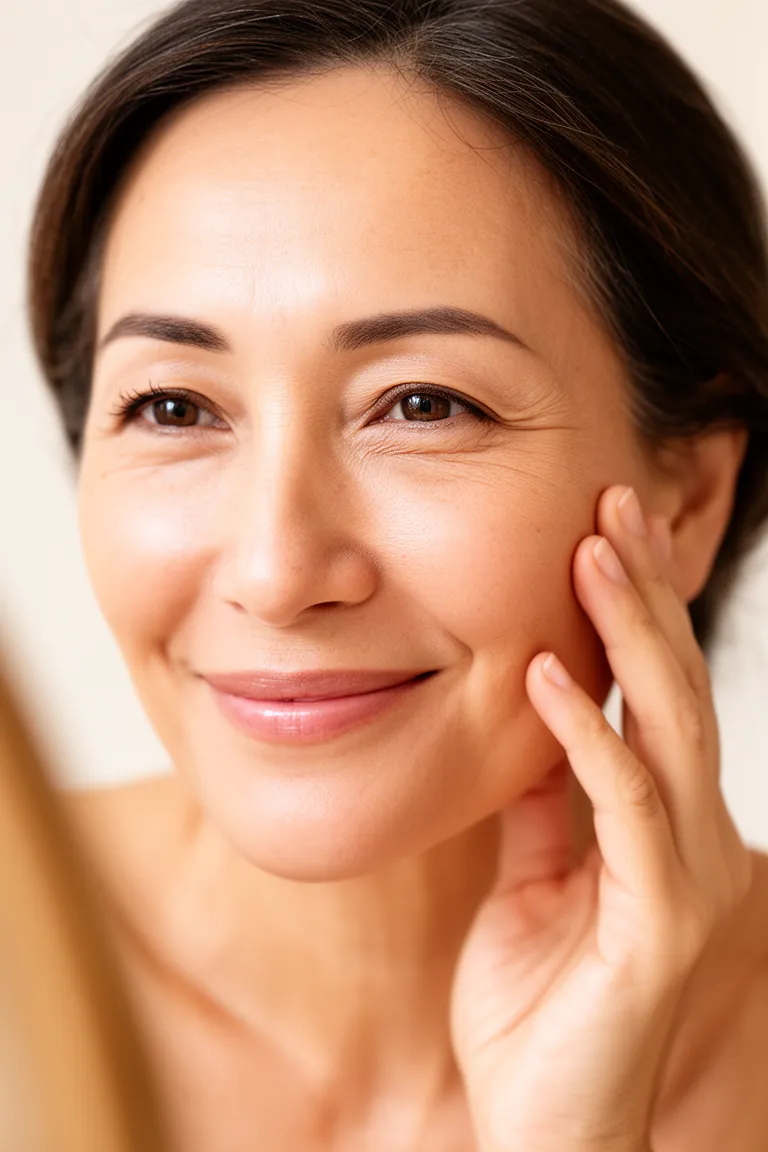
I was pulling on a turtleneck one morning last winter when I saw it in the harsh bathroom light. As I stretched the fabric over my head, the skin on my neck didn’t snap back the way it used to. It just… lingered. It felt thinner, looser, like delicate tissue paper that had been crumpled and smoothed out one too many times. I stood there, frozen, a 47-year-old woman who prides herself on doing everything right. I eat my greens, drink my water, run three times a week, and I’ve been a sunscreen devotee since my twenties. I’d earned my laugh lines, but this felt different. This wasn’t character; it was a quiet deflation. A sinking feeling settled in my stomach: After all that work, is this just what happens now?
That moment sparked a frantic, expensive, and frankly exhausting year. I dove into the world of firming creams promising “lifting miracles,” choked down chalky collagen drinks, and layered serums until my skin protested with redness. I was chasing the bounce, the spring, the resilience I felt I’d lost overnight. And with every product that failed to deliver, my frustration grew. I wasn’t asking for my 30-year-old skin back; I just wanted to feel like my healthy habits were reflected in my reflection. I felt betrayed by my own routine.
It was only when I stepped back from the marketing hype that I found my way out of the cycle. I discovered that restoring skin elasticity after 40 isn’t about finding a single hero product. It’s a quieter, more consistent strategy built on supporting what you have, gently encouraging renewal, and understanding what’s realistically in your control. This is the story of how I moved from scattered frustration to a place of realistic, visible improvement.
The Morning I Realized My Skin Had Lost Its Bounce
That moment with the turtleneck wasn’t about wrinkles. It was about a fundamental quality I’d taken for granted: elasticity. After 40, skin elasticity isn’t just about avoiding fine lines; it’s about the skin’s ability to stretch and recoil, its thickness, and its overall structural integrity. What I was seeing was a creeping laxity and a crepey texture, especially around my neck and eyes—areas where the skin is thinnest. It felt like my foundation was subtly shifting.
What Skin Elasticity Means After 40
I used to think elastic skin just meant fewer wrinkles. But I learned it’s more about the underlying architecture. Imagine your skin’s support system—collagen and elastin fibers—as a brand-new, springy mattress. Over decades, those springs lose tension. The mattress still functions, but it doesn’t bounce back with the same vigor. That’s what was happening to me. My skin wasn’t just lined; it was losing its underlying “oomph.”
Crepey Texture Versus Dehydration and Laxity
I initially brushed it off as dehydration. I loaded up on hyaluronic acid, drank even more water, but while my skin felt plumper, it didn’t regain that snap. The crepey texture versus dehydration was a crucial distinction I had to learn. Dehydration is a temporary lack of water, like a raisin that can plump back into a grape. What I was experiencing was a longer-term change in the skin’s scaffolding—the raisin itself had changed shape. The skin was literally thinner, with less structure underneath to hold it taut.
When Sudden Changes Warrant Medical Advice
I also had to ask myself when sudden changes warrant medical advice. While my journey was gradual, I learned that any rapid, significant sagging, pronounced textural change, or new laxity should prompt a visit to a dermatologist. It’s important to rule out other factors like sudden weight loss, thyroid issues, or other health changes. For me, it was the slow, relentless creep of time, finally making itself undeniable in that stark morning light.
Why Healthy Habits Alone Did Not Restore My Skin Elasticity After 40
This was the heart of my confusion, and my frustration. I was doing the work! I was the friend who brought salad to the barbecue and reapplied SPF at the beach. Why wasn’t I seeing the results? My journey to understand this led me to some humbling, but ultimately freeing, truths. It explained why I felt my skin losing elasticity after 40 despite wearing sunscreen and eating well.
How Collagen and Elastin Change with Age
Our bodies simply produce less of these critical proteins starting in our mid-20s, and the decline picks up pace post-40. But it’s not just about quantity; it’s about quality. The existing fibers become more disorganized, brittle, and fragmented. Think of a well-worn sweater where the threads are fraying and the knit is looser. No amount of topical moisturizer can re-weave that fabric from the outside. This structural shift is the core reason why healthy habits alone did not restore my skin elasticity after 40.
Cumulative UV Exposure and Photoaging
Then there’s the silent culprit: cumulative UV exposure. My lifelong sunscreen habit was—and is—my best defense, but it wasn’t a complete eraser. The sun exposure from my teenage years and twenties, the damage I thought I’d dodged by becoming vigilant in my 30s, had a cumulative “memory” that was now expressing itself. Sunscreen prevents new damage; it doesn’t magically reverse the old. Photoaging works deep in the dermis, breaking down collagen like a slow, invisible fire. Functional integrity of aging skin, from cutaneous biology to anti-aging...
Perimenopause, Menopause, and Lower Estrogen
Just as I was grappling with this, my body decided to add another layer. The hormonal rollercoaster of perimenopause and menopause, where lower estrogen levels directly impact collagen production and skin thickness, became a major player. Estrogen is like a foreman on the collagen construction site; when it dips, production slows way down. My body’s chemical landscape was shifting, and my skin was the most visible map.
Why Diet, Exercise, Sleep, and Hydration Have Limits
Most importantly, I had to accept that my pillars of health—diet, exercise, sleep, and hydration—have limits. They are the essential, non-negotiable foundation for everything. They support your skin from the inside, reducing inflammation and providing building blocks. But they cannot single-handedly halt or reverse the structural aging process that’s governed by genetics, time, and past sun exposure. They are the fertile soil, but they don’t control the weather or turn back the seasons. This realization was painful but pivotal. It meant I wasn’t failing; I was facing a biological reality that required a more nuanced, targeted approach beyond lifestyle alone.
The Skincare Mistakes I Made While Chasing Firmer Skin
Armed with panic and a credit card, I became my own worst enemy. My quest to improve loose crepey skin after 40 naturally turned into a cycle of disappointment because I was making all the classic errors. I see now that I was wasting money on collagen supplements and firming creams because I didn’t understand their true role.
Over-Exfoliation and a Damaged Skin Barrier
In my quest for “renewed” skin, I used acids and scrubs too frequently, stripping away my protective lipid layer. I thought I was sloughing off dead skin to reveal firmer skin underneath. Instead, I left my skin red, irritable, tight, and even more vulnerable to moisture loss—the exact opposite of resilient. I was tearing down the very walls I needed to reinforce. A compromised barrier can’t hold hydration, and it certainly can’t support the repair processes I was trying to stimulate.
Why Miracle Creams Cannot Lift Loose Skin
I also fell hard for the promise of miracle creams. I spent a small fortune on luxurious jars that claimed to “lift” and “tighten.” The cold, hard truth I learned is that no topical cream can lift loose skin. Creams can hydrate, plump temporarily with humectants, and improve surface texture, but gravity and structural loss are forces they cannot overcome. I was expecting architectural changes—a renovation—from a product that only works on the wallpaper.
What Collagen Supplements Can and Cannot Do
Then came the collagen supplements. I wanted so badly to believe that drinking my collagen would translate directly to firmer skin. I’d ask myself, “Am I wasting money on collagen supplements for skin elasticity?” The honest answer is: they’re not a magic bullet. The research on oral collagen is interesting for supporting joint comfort and skin hydration, which is valuable. But the evidence that it significantly restores lost facial elasticity after 40, on its own, is not as robust as the marketing suggests. Your body breaks it down into amino acids and uses them where it sees fit, not necessarily where you want them. It’s a supportive player in the ensemble, not the soloist. I tried collagen boosting skincare products and my skin still looks tired.
Ingredient Conflicts and Irritation Signals
Finally, I created a nightly chemistry experiment on my face. I layered retinol with potent vitamin C and exfoliating acids all in one go, desperate for overnight results. My skin screamed in protest with stinging, peeling, and persistent redness—classic irritation signals I ignored, thinking it was “purging” or working. In reality, inflammation is a major accelerator of skin aging. I was so focused on the destination, I was burning down the road to get there.
What Finally Made My Routine More Realistic: SPF, Barrier Care, and Retinoids
After the year of frustration, I threw out half my products and started over with a new philosophy: support first, stimulate gently. The goal wasn’t to fight my skin but to partner with it. This shift led me to what I now consider the core trio for the best skincare routine for skin elasticity after 40.
A Simple Morning Routine for Mature Skin
My new morning became beautifully simple and focused on defense and nourishment. I use a gentle, non-foaming cleanser or just rinse with water. While my skin is still damp, I apply a vitamin C serum—its main job is antioxidant protection, neutralizing free radicals before they can damage collagen. Then, a moisturizer packed with barrier-supporting ingredients like ceramides, glycerin, or niacinamide. Niacinamide, in particular, became a hero for helping to strengthen my barrier and improve skin tone. Finally, the non-negotiable: a broad-spectrum SPF 30 or higher. This routine isn’t about attacking; it’s about daily fortification.
How to Introduce Retinoids Gradually
The real game-changer, introduced with the patience of a saint, was a retinoid. I had to learn that retinol helps restore skin elasticity after 40 not by adding it, but by encouraging your skin to do better work itself. I started with the lowest concentration I could find, applying it once a week, over top of my moisturizer to “buffer” it. After a month with no irritation, I moved to twice a week. It was a six-month journey to nightly use. Retinoids work at a cellular level to speed up turnover and, crucially, signal for new collagen production. They don’t add elasticity, but they help improve the quality and density of the skin you have.
Moisturizers with Ceramides, Glycerin, or Niacinamide
I stopped chasing fancy names and started looking for these workhorse ingredients. A strong skin barrier is the foundation of everything. When it’s intact, it keeps moisture in and irritants out, allowing active ingredients like retinoids to work without causing havoc. A simple, effective moisturizer became more valuable to me than any expensive serum.
Where Peptides, Vitamin C, and Hyaluronic Acid Fit
I reintegrated other ingredients with clear, realistic roles. Peptides are like little messengers that can signal to the skin to support collagen, and I use them in my morning serum. Hyaluronic acid is a hydration magnet, perfect on damp skin, but I know it’s a temporary plumping effect. Vitamin C, as mentioned, is my morning antioxidant shield. They all have a seat at the table, but they’re not the head of it.
Retinoid Safety, Pregnancy, Menopause, and Sensitive Skin
This education was critical. I learned retinoid safety inside and out: the imperative of daily sunscreen, that they are not recommended during pregnancy or breastfeeding, and that if you have rosacea or extremely sensitive skin, you must proceed with extreme caution or under a doctor’s guidance. For menopausal skin that can be drier, buffering and slow advancement are key. It’s powerful, but it’s not for every person or every life stage.
Navigating the Options: From Home Care to Professional Help
Once I had my consistent home routine down, I could look at the bigger picture with clearer eyes. I realized my approach to restoring skin elasticity after 40 when nothing seems to work needed to be tiered, matching the level of intervention to the level of change I was seeking. This is when I stopped seeing my skincare as a single solution and started seeing it as part of a spectrum.
| Approach | Best For | Realistic Timeline for Visible Change | Key Consideration |
|---|---|---|---|
| The Foundational Routine | Anyone starting out or wanting to maintain health. Focus on SPF, gentle cleansing, barrier repair, and hydration. | 4-8 weeks for improved hydration, calmness, and glow. | This is non-negotiable for everyone. It prevents further damage and creates the ideal canvas for any other treatment. |
| Foundational + Active Ingredients | Those seeing early textural changes, fine lines, or mild laxity who are ready for a committed routine. Adds retinoids, antioxidants, peptides. | 3-6 months for improved texture, finer lines, and subtle firming. | Requires patience, consistency, and careful introduction to avoid irritation. Manages expectations for topical products. |
| Professional In-Office Treatments | Significant laxity, crepey skin, or volume loss that hasn’t responded to topicals. For those seeking more dramatic structural change. | Varies; some treatments show initial results in weeks, with full collagen remodeling taking 3-6 months. | Involves cost, potential downtime, and requires a qualified provider. Not a one-time fix; maintenance is typically needed. |
This framework helped me understand exactly where I was and what each path could realistically offer. It took the emotion out of the decision and made it strategic.
Scientific Evidence
How Long It Took to Notice a Difference—and When I Considered Professional Treatment
I had to reset my expectations entirely. In a world of 15-second TikTok transformations, I was on a slow, steady path. This was the most important lesson in my experience improving skin elasticity after 40.
Expected Timelines for Hydration, Texture, and Fine Lines
With my new, gentle routine, I noticed my skin felt calmer and more comfortable within a week. Improved hydration and a brighter glow came in about a month. But I had to ask myself, “How long does it take to improve skin elasticity after 40?” with real honesty. Meaningful changes in texture and fine lines? That took a solid three to six months of unwavering consistency. The subtle improvement in my skin’s firmness and that crepey texture around my eyes was so gradual I’d notice it only by comparing photos over time, not in the mirror day-to-day. The “bounce” returned incrementally, not dramatically. how to get rid of fine lines around eyes.
Topicals Versus Professional Procedures
This led me to a crucial, honest distinction. My retinoid and peptides were doing good work on the surface and upper layers. But for the significant laxity I saw when I tilted my head back, they have limits. I started researching procedures like microneedling, laser resurfacing, radiofrequency, and ultrasound (like Ultherapy). These tools work deeper, creating controlled micro-injuries or heating the deeper layers to trigger a robust, healing-driven collagen-building response that topicals simply cannot achieve.
How to Evaluate Procedures, Risks, and Maintenance
Learning how to evaluate procedures became my next step. I talked to dermatologists, not salespeople. I learned about downtime (from none to several weeks), costs (significant), risks (like scarring or pigment changes if not done properly), and the need for maintenance treatments. It’s a medical decision, not a skincare purchase. This research was empowering, not discouraging. It helped me appreciate what my home routine could realistically achieve and where professional help might one day fit in.
When to See a Dermatologist
This journey cemented for me when to see a dermatologist: not just when you’re desperate, but when you’re ready for guided, personalized advice. Go to assess your skin’s specific needs, to get a safe prescription-strength retinoid (like tretinoin), or to explore in-office options with a clear understanding of potential outcomes. They are the expert navigators for home-care.
The Mindset Shift That Made All the Difference
The biggest change wasn’t in a bottle; it was in my head. I stopped seeing my skin as a problem to be fixed and started seeing it as a partner to be cared for. The chase for a quick fix was what left me frustrated and with thinner skin, both literally and emotionally. Now, my routine is a practice in consistency and kindness, not a desperate search for a miracle. When I turned 40 my skin lost its bounce, and what helped wasn’t a product, but perspective. My skin isn’t 25 again, and it never will be. But it’s healthier, stronger, more resilient, and the best version of itself at 47. And that feels like a victory I can build on for the next decade.
Frequently Asked Questions

Q: I’ve tried everything to restore skin elasticity after 40 and feel stuck. Where should I really start? A: I know that feeling intimately. Start by hitting pause on all active ingredients (retinoids, strong acids, potent vitamin C) for two weeks. Focus only on a gentle cleanser, a rich moisturizer with ceramides or niacinamide, and your daily sunscreen. This resets your barrier, which is often the hidden culprit. Once your skin feels calm and hydrated, then—and only then—reintroduce one active, like a retinoid, with a “start low and go slow” approach.
Q: How long does it take to see real results from a new skincare routine aimed at elasticity? A: It’s important to manage expectations. You might see improved hydration and a brighter complexion within 4-6 weeks. However, significant improvements in skin texture, fine lines, and a subtle firming effect from ingredients like retinoids typically take 3 to 6 months of consistent, daily use. Building collagen is a slow biological process, so patience and consistency are your most important products.
Q: I’ve heard retinoids are the gold standard, but they irritate my skin. What can I do? A: This is very common, especially for sensitive or mature skin that may be drier. The key is to start low and go slow. Begin with the lowest concentration and apply it only once or twice a week, over top of your moisturizer to buffer it. Gradually increase frequency as your skin tolerates it. If irritation persists, consider asking a dermatologist about even gentler prescription options or switch to bakuchiol, a plant-based alternative that’s much kinder for some people.
Q: Are collagen supplements a waste of money for skin elasticity? A: They’re not necessarily a waste, but they are often overhyped. The science suggests certain collagen peptides can improve skin hydration and may support skin density over time. However, view them as a potential supportive piece of the puzzle, like taking a multivitamin. They will not dramatically restore lost elasticity on their own. Your money and focus are better spent first on a stellar topical routine and sunscreen.
Q: When should I consider professional treatments instead of just topical products? A: Consider professional treatments if you’re dealing with significant skin laxity (noticeable sagging), deep folds, or volume loss that hasn’t responded to a diligent, consistent topical routine after a year or more. Topicals work on the surface and upper layers; procedures like radiofrequency, ultrasound, or laser resurfacing work deeper to stimulate collagen. A consultation with a board-certified dermatologist is the best way to determine if you’re a good candidate and what type of treatment aligns with your goals.
Q: What’s the one thing I should prioritize above all else? A: Without a doubt, daily broad-spectrum sunscreen (SPF 30 or higher). All the collagen-building serums and treatments in the world are fighting a losing battle if you’re not protecting your skin from daily UV damage, which actively breaks down collagen and elastin. Sunscreen is the ultimate preventative and supportive measure for maintaining whatever elasticity you have. It’s the bedrock of everything else.
📌 Love this guide? Save it on Pinterest!
Pin Restore Skin Elasticity After 40: My Realistic Journey & What Actually Works in 2026 to your board so you can come back to it later.

